All ads / Ad 2
Athletics Makes the Grade
A report card on what athletic success does for a university.
The ad, in full
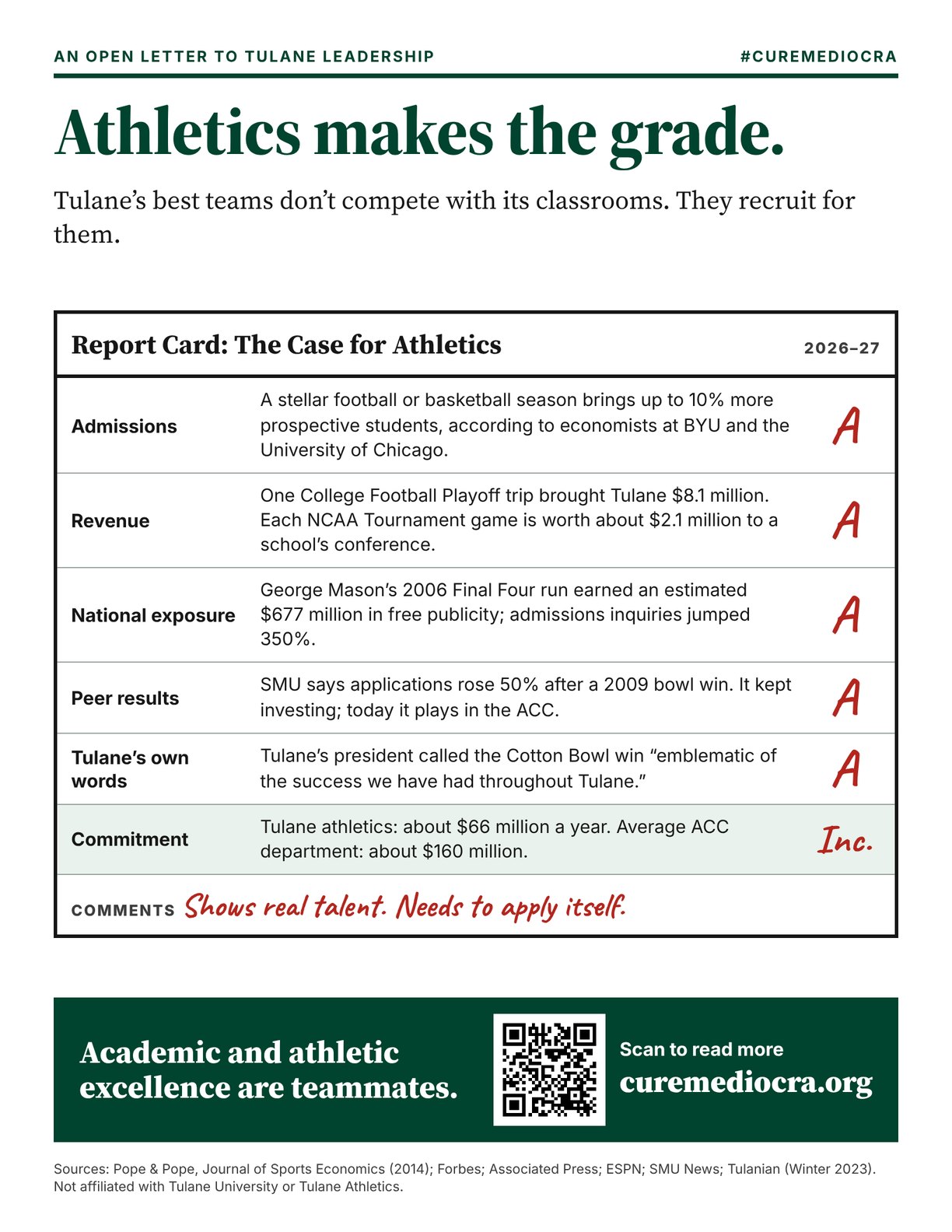
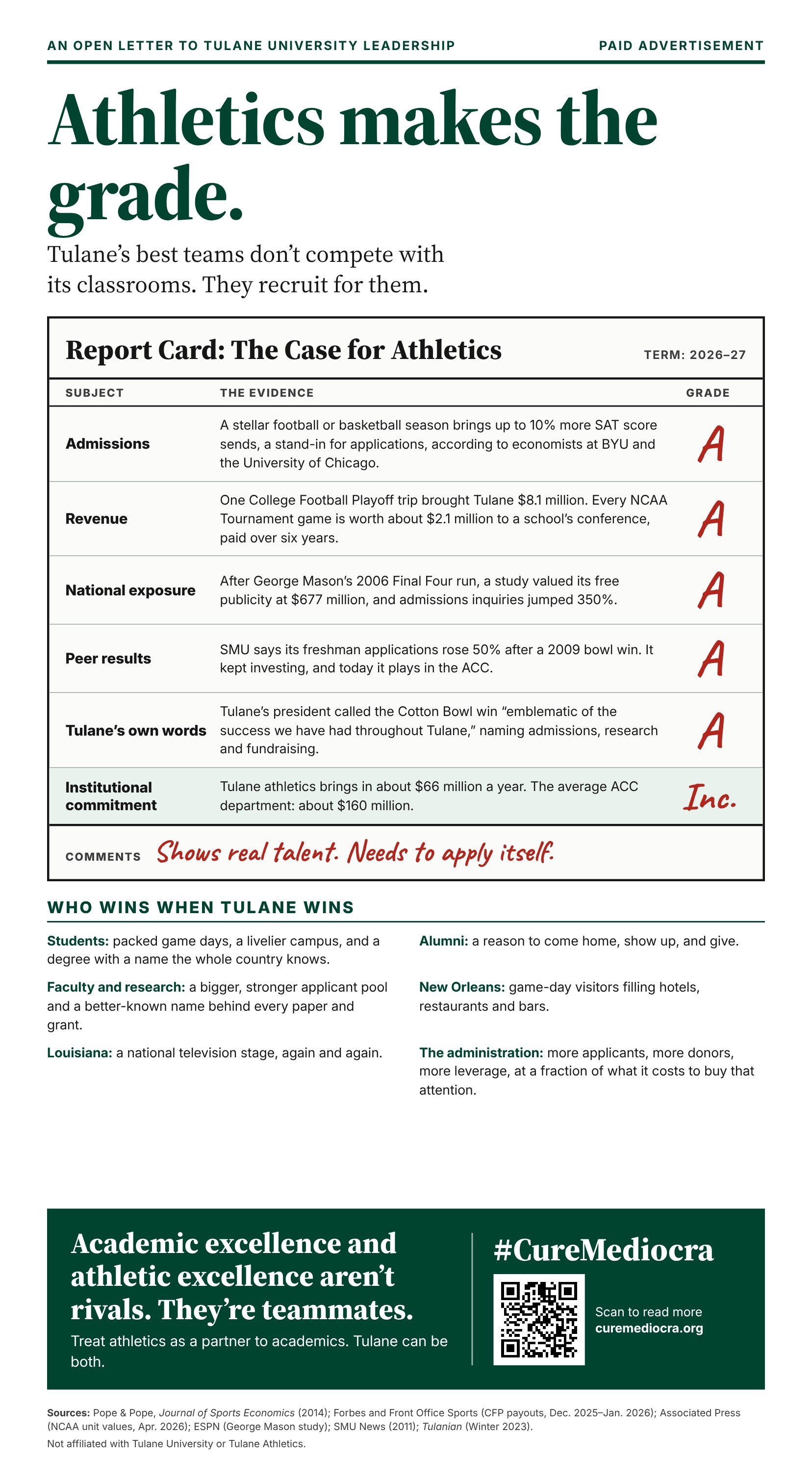
Tulane’s best teams don’t compete with its classrooms. They recruit for them.
Our report card on the case for athletics:
| Subject | The evidence | Grade |
|---|---|---|
| Admissions | A stellar football or basketball season brings up to 10% more prospective students, according to economists at BYU and the University of Chicago. | A |
| Revenue | One College Football Playoff trip brought Tulane $8.1 million. Each NCAA Tournament game is worth about $2.1 million to a school’s conference, paid over six years. | A |
| National exposure | After George Mason’s 2006 Final Four run, a study valued its free publicity at $677 million, and admissions inquiries jumped 350%. | A |
| Peer results | SMU says its freshman applications rose 50% after a 2009 bowl win. It kept investing, and today it plays in the ACC. | A |
| Tulane’s own words | Tulane’s president called the Cotton Bowl win “emblematic of the success we have had throughout Tulane,” naming admissions, research and fundraising. | A |
| Institutional commitment | Tulane athletics brings in about $66 million a year. The average ACC department: about $160 million. | Incomplete |
Teacher’s comment: Shows real talent. Needs to apply itself.
Who wins when Tulane wins
- Students: packed game days, a livelier campus, and a degree with a name the whole country knows.
- Alumni: a reason to come home, show up and give.
- Faculty and research: a bigger, stronger applicant pool and a better-known name behind every paper and grant.
- New Orleans: game-day visitors filling hotels, restaurants and bars.
- Louisiana: a national television stage, again and again.
- The administration: more applicants, more donors and more leverage, at a fraction of what it costs to buy that attention.
Academic excellence and athletic excellence aren’t rivals. They’re teammates.
Sources: Pope & Pope, Journal of Sports Economics (2014); Forbes and Front Office Sports (CFP payouts, Dec. 2025–Jan. 2026); Associated Press (NCAA unit values, Apr. 2026); ESPN (George Mason study); SMU News (2011); Tulanian (Winter 2023).